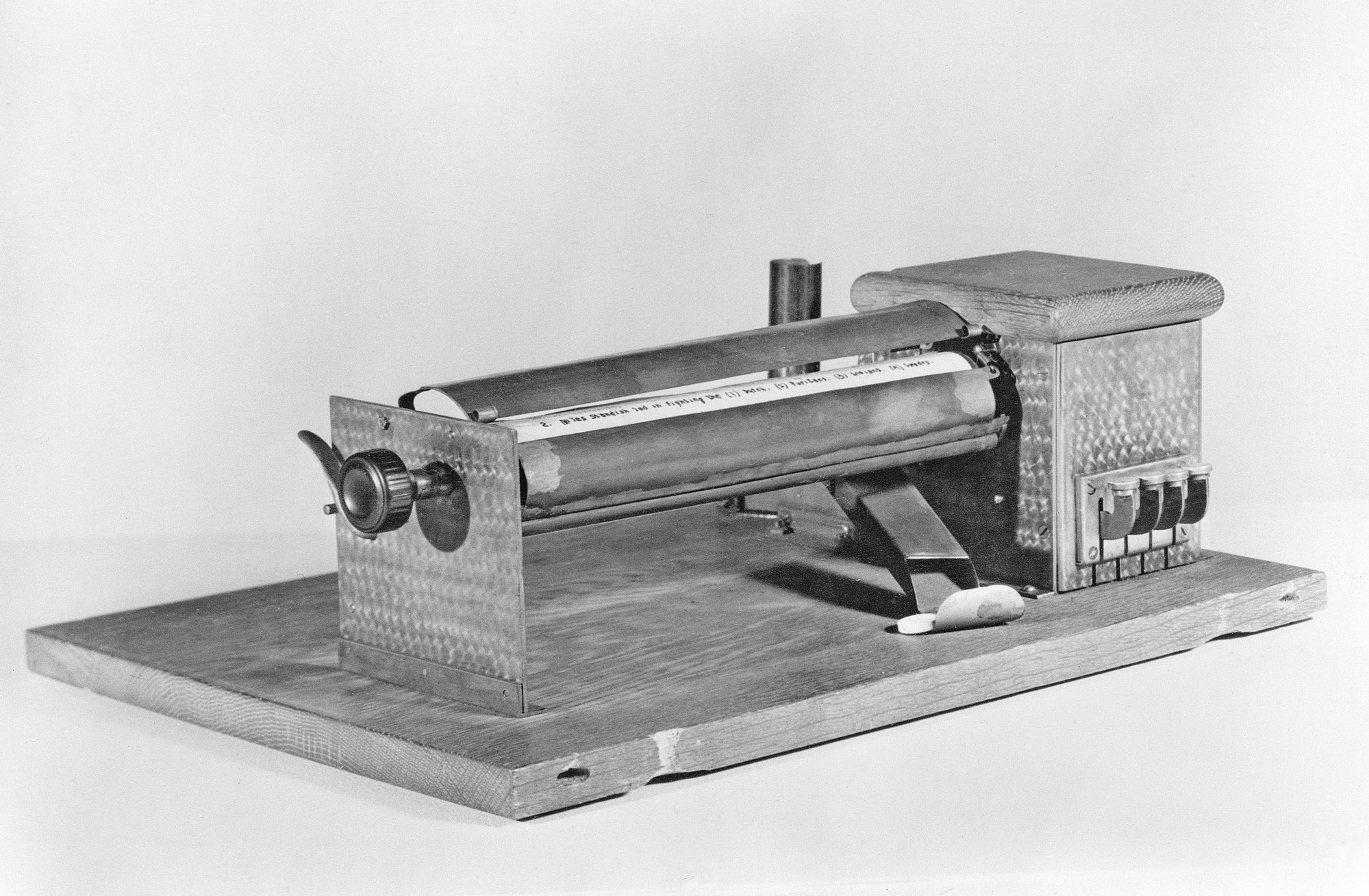
In 1924, Sidney L. Pressey, professor of psychology at Ohio State University, developed what is considered by many to be the first teaching machine. In practice it was a box with typed questions, with 4 multiple choice numbered answers. The box allowed the "test" model that added the correct answers, or the "teach" model that did not allow to advance until the answer was correct.
Apparently, one of the supposedly most consensual definitions of teaching machines would be in line with the following criteria: A teaching machine is an automatic or self-controlling device that (a) presents a unit of information (B. E Skinner would say that the information must be new), (b) provides some means for the learner to respond to the information, and (c) provides feedback about the correctness of the learner's responses. (Benjamin, 1988). For us, more than the definition and whether the Pressey Machine corresponds to the criteria, we are interested in understanding the emergence of these criteria and what informs them. Self-controlling, information and feedback were not such common concepts in the 1920s. On the other hand, Pressey seems to be a pioneer of cognitive discourse and programmed learning. The fact is that his machines did not have receptivity at that time.
B. F. Skinner also became interested in teaching machines from 1953 onwards, even publishing the text "Teaching by Machine" in 1954. Upon reading this text, Pressey corresponds with Skinner sending him his work. According to Skinner, Pressey machines are more testing machines than teaching machines, since they are not teaching new material and rely on previous study by students. Skinner begins to develop his machines with the aim of introducing 'new' matter.
We can read many common desires and assumptions between Pressey and Skinner, from the idea of cognitive work being mechanized, to how this mechanization can free the teacher's work and lead to self-instruction. Despite these common dimensions, generally on the order of pragmatism and efficiency, the epistemological starting points are quite different, even though they point to a common territory. Between Skinner's behaviorism and Pressey's cognitivism, there is a cybernetic territory that unites them. If, at the outset, this would be more readable in Pressey, the fact is that Behaviorism is also based on the feedback model, although with the term "reinforcement" in its place. Indeed, Skinner and Norbert Wiener (a key figure in cybernetics) worked during World War II on similar challenges. While Wiener was trying to calculate aircraft trajectories, Skinner was developing a project that used pigeons to guide missiles. Post-war education discourses, particularly about teaching machines, often appear in a military context and seem to be anchored between theories of information and animal behavior. In this respect, Pressey makes his position very clear in the article "Teaching Machine (and Learning Theory) Crisis", first presented at the American Psychological Association in 1962 and published a year later in the Instructors' Journal of the Department of the Air Force Recurring Publication. :
"The archvillain, leading so many people astray, is declared to be learning theory! No less a charge is made than that the whole trend of American research and theory as regards learning has been based on a false premise—that the important features of human learning are to be found in animals. Instead, the all-important fact is that humans have transcended animal learning. Language, number, such skills as silent reading, make possible facilitations of learning, and kinds of learning, impossible even for the apes, Autoinstruction should enhance such potentials. Instead, current animal derived procedures in autoinstruction destroy meaningful structure to present material serially in programs, and replace processes of cognitive clarification and largely rote reinforcements of bit learnings"
Information theory and animal behavior in a war scenario, only a creative child could symbolize hope and peace, for the world and for education.
TA