
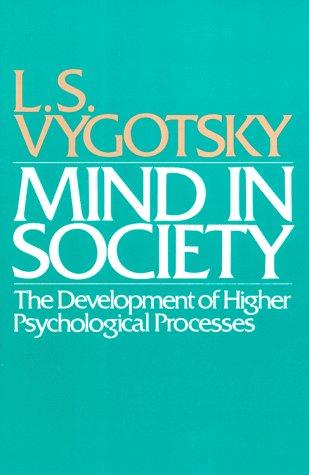
This book puts together and edits essays and materials from different sources in order to bring to western academics the views of the mind that were present in Vygostky’s works that because of historical and political reasons (including the cold war) were relatively unknown and untranslated in the west until the 1960s.
One of issues that the book addresses, in one of its chapters, is the issue of play, in its relationship with imagination and child development.
Closely linked to imagination, play is seen as having an important role in changing the child’s relation to reality: the (small) child becomes less determined by what are her surroundings and what she sees, and progressively more by meanings and motives. As Vygotsky puts it, “in play, things lose their determining force. The child sees one thing but acts differently in relation to what he sees.” (L. S. Vygotsky, 1978, pp. 96–97). By allowing the child to act with meanings as with objects, play creates conditions for “emancipation from situational constraints” (L. S. Vygotsky, 1978, p. 99). Even though this opens possibilities of spontaneity and freedom in play, Vygotsky is clear that in fact, through play, the child learns self-control and self-determination by learning to subordinate herself to rules - “the essential attribute of play is a rule that has become a desire. (…) play gives a child a new form of desires. It teaches her to desire by relating her desires to a fictious”I”, to her role in the game and its rules.” (L. S. Vygotsky, 1978, pp. 99–100).
If play creates the (imaginary) space where the child develops meanings, motives, desires and will, and if it also facilitates the situations, social and psychological, where the child learns to subordinate herself to rules, to act within self and other, imaginary even, determined boundaries and im/possibilities, it can be transformed into a (educational) technology.
Which forms of play became instrumental as educational technologies? And to which (and whose) ends?
PF
Comments
This edited volume revisits…
This edited volume revisits Lev Semyonovich Vygotsky`s most important essays on psychological and developmental theories which have not been recognized much in the West. Only the publishing of this edited volume gave space and attention to his works on the North American continent.