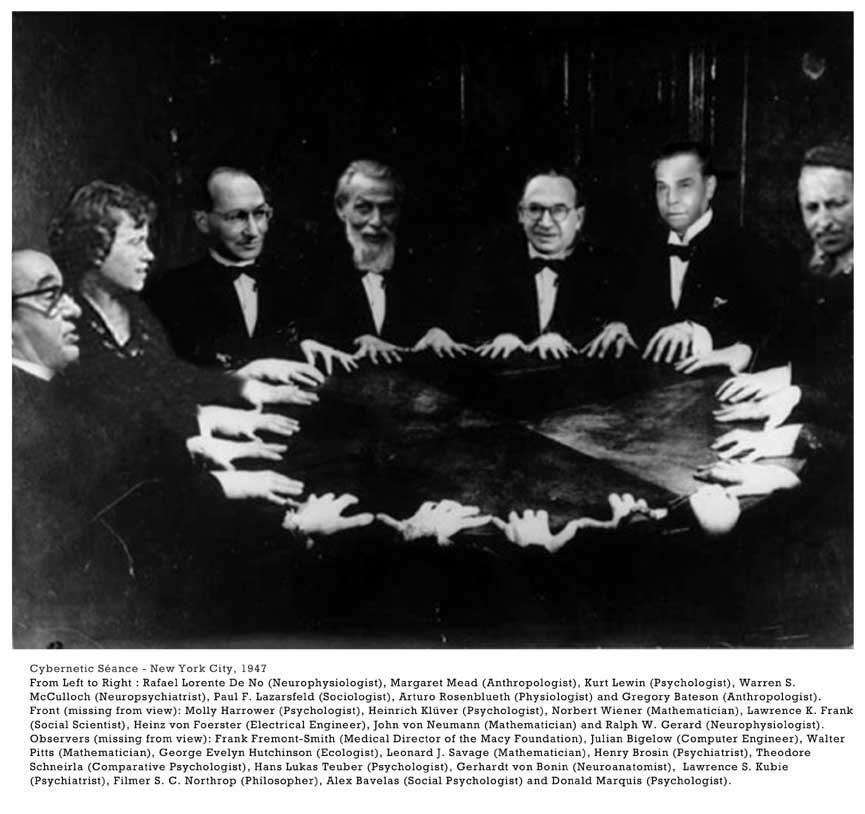
The Macy conferences were a series of interdisciplinary scientific meetings held in New York between 1941 and 1960. Interdisciplinarity was in itself one of the major objectives of conferences that brought together scientists from different areas to break down disciplinary boundaries. Medicine would occupy an important place, not only because of the sponsor dedicated to health, Josiah Macy Jr. Foundation, as well as the isolation felt as a discipline in the face of the need to relate to areas such as, for example, nuclear physics or society (p. vii). Not by chance, with the aim of interdisciplinarity and communication between sciences, from 1946 onwards, a new area began to be formed and systematized: cybernetics. The group included people from various fields such as: Frank Fremontsmith, Gregory Bateson, Kurt Lewin, J. C. R. Licklider, Margaret Mead, Walter Pitts, Claude Shannon, Heinz von Foerster, John von Neumann, Norbert Wiener, Warren McCulloch.
Taking the theory of information, communication, media and concepts such as central feedback and homeostasis, cybernetics placed themselves as objects of their experiments. The science communicator was observed and analyzed in his own activity. It becomes difficult to discern how much of their social life was projected onto the experience and theory of cybernetics. The creative, white, upper-middle-class American researcher became the model open-minded citizen (Cohen-cole) that America needed for postwar peace. In the 1955 edition, The Expression of the Emotions in Man and Animals, with a preface by Margaret Mead, photographs of researchers engaged in communicative activity were added at the end of the book. These researchers seem to be one more stage of the Darwinistic development, in its structure and racializing science. A step to be reached based on new discourses and educational models.
According to Jean-Pierre Dupuy, the creed of cybernetics was based on:
1. "Thinking is a form of computation. The computation involved is not the mental operation of a human being who manipulates symbols in applying rules, such as those of addition or multiplication; instead it is what a particular class of machines do — machines technically referred to as “algorithms.” By virtue of this, thinking comes within the domain of the mechanical.
2. Physical laws can explain why and how nature — in certain of its manifestations, not restricted exclusively to the human world — appears to us to contain meaning, finality, directionality, and intentionality.
They thought themselves capable of reconciling the world of meaning with the world of physical laws. Thanks to them, the mind would at last find its rightful place in nature."
Mind, machine and nature can finally mingle. The reproduction of nature will be able to continue more harmoniously and efficiently than ever, such as the desire of a distinguished lord of artistic education, author of “Prophesies for the Twentieth Century”.
The cybernetic meetings of the Macy Conferences ended in 1953, configuring cognitive sciences on the one hand, on the other hand, passing through second-order cybernetics (cybernetics of cybernetics), the core of the discussion seems to have continued in what came to be known as artificial intelligence.
TA