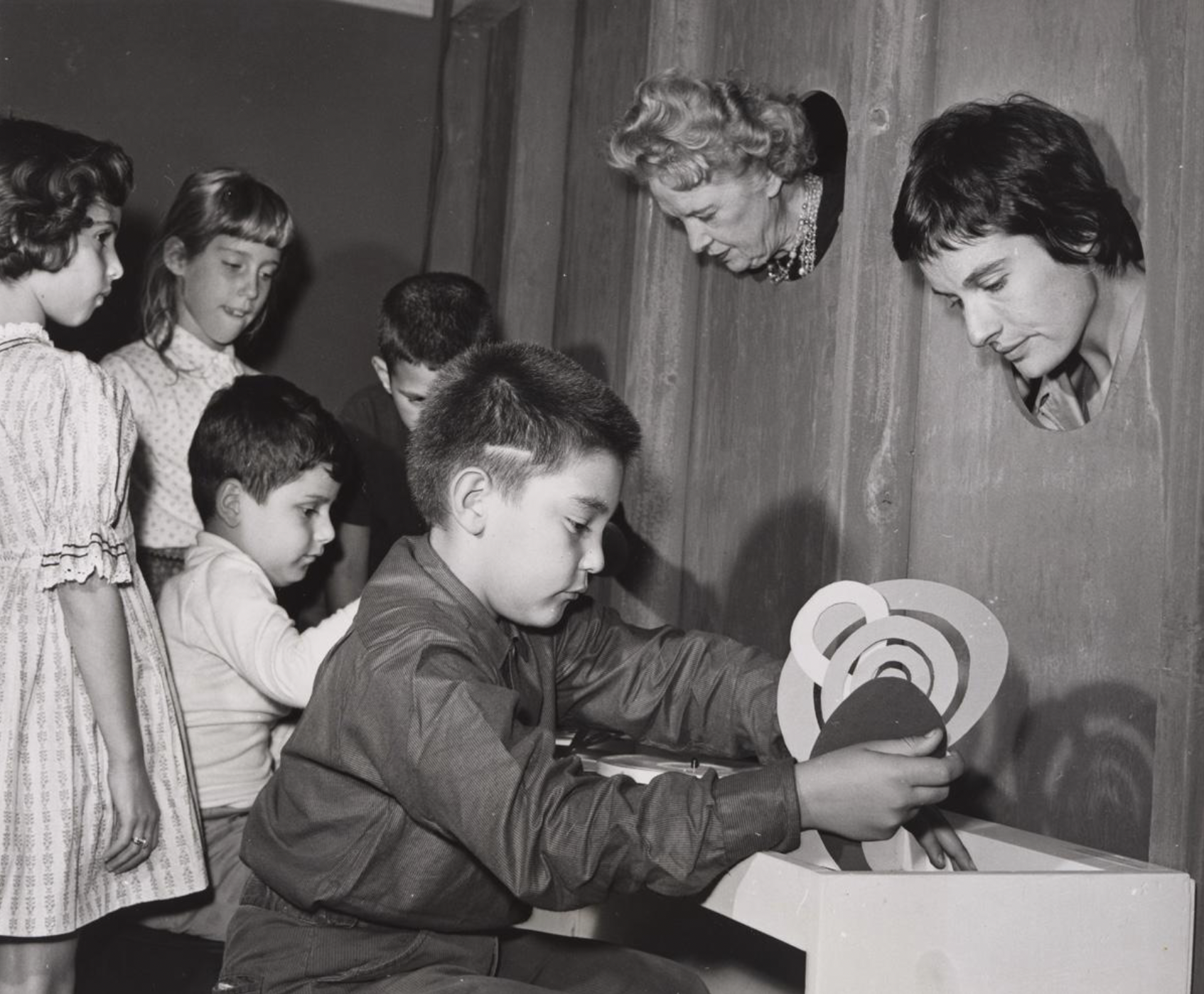
As Victor D’Amico, founding director of MoMA’s Department of Education, wrote, “If a four-year-old comes into the museum, for example, he sees practically nothing. He sees the bottom of things. If he goes to the sculpture gallery he sees the pedestal. If he goes to the painting gallery he sees the bottoms of paintings or, more so, he often sees adult legs in front of him.” For D’Amico—who believed in the humanizing power of art and children’s innate creative ability—this needed to change. Enter the Children’s Art Carnival. One of many youth education initiatives D’Amico spearheaded during his three decades at MoMA, the Children’s Art Carnival was inaugurated in 1942 and featured an exhibition space with toys, touchable artworks, and even modern masterpieces from the collection (such as hanging mobiles by sculptor Alexander Calder) installed at a child’s eye level. An adjacent studio area was outfitted with art supplies so that children could make work of their own. Contained within structures set up inside Museum galleries, the carnival was only accessible via child-shaped cutouts. Adults were blocked from entering due to D’Amico’s conviction that when children “become aware of adults being present” they develop inhibitions, but they were allowed to watch their children at the gate or through especially designed portholes. The event was thrown annually at MoMA for almost two decades, while also traveling to Europe in the mid-’50s, and to India in 1963. In 1969, under the leadership of Betty Blayton-Taylor, the Children’s Art Carnival moved to Harlem, where it became a separate nonprofit entity in 1973.


Comments
As Victor D’Amico, founding…
As Victor D’Amico, founding director of MoMA’s Department of Education, wrote, “If a four-year-old comes into the museum, for example, he sees practically nothing. He sees the bottom of things. If he goes to the sculpture gallery he sees the pedestal. If he goes to the painting gallery he sees the bottoms of paintings or, more so, he often sees adult legs in front of him.” For D’Amico—who believed in the humanizing power of art and children’s innate creative ability—this needed to change. Enter the Children’s Art Carnival. One of many youth education initiatives D’Amico spearheaded during his three decades at MoMA, the Children’s Art Carnival was inaugurated in 1942 and featured an exhibition space with toys, touchable artworks, and even modern masterpieces from the collection (such as hanging mobiles by sculptor Alexander Calder) installed at a child’s eye level. An adjacent studio area was outfitted with art supplies so that children could make work of their own. Contained within structures set up inside Museum galleries, the carnival was only accessible via child-shaped cutouts. Adults were blocked from entering due to D’Amico’s conviction that when children “become aware of adults being present” they develop inhibitions, but they were allowed to watch their children at the gate or through especially designed portholes. The event was thrown annually at MoMA for almost two decades, while also traveling to Europe in the mid-’50s, and to India in 1963. In 1969, under the leadership of Betty Blayton-Taylor, the Children’s Art Carnival moved to Harlem, where it became a separate nonprofit entity in 1973.
https://www.moma.org/interactives/moma_through_time/1940/the-childrens-art-carnival/