

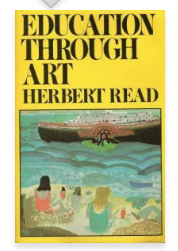
First published in 1943, Education through Art by Herbert Read is still considered one of the urtexts of arts education today. The text was translated into several languages and influenced arts education practices in many contexts.
“The argument of this book is that the purpose of education, as of art, should be to preserve the organic wholeness of man and of his mental faculties, so that as he passes from childhood to manhood, from savagery to civilisation, he nevertheless retains the unity of consciousness which is the only source of social harmony and individual happiness.”
Rooted in the emergent fields of psychology and the educational sciences, Education through Art promotes the idea that children’s drawings can be studied by psychologists and educators to assess their creative and mental abilities. These assessments were based on a typology of the child that constituted the possibility of deviant and normalized childhood, hinged on the modern notion of the child as developing and progressing.
The linkage of developmentalism with recapitulation theory allowed educators and psychologists to equate the stages of development of an embryo of an animal to the development of the child as well as the evolution of societies. This, in turn, gave way to the equation of the child as ‘primitive’. Visual affinities of children’s drawings and the visual production by peoples who were rendered ‘primitive’ by the logic of coloniality were mobilized as evidence for those theories. Those visual affinities were amongst others the usage of ‘basic’ shapes such as lines and spirals.
“What is more significant for our present purpose is that this description of the savage’s artistic activities agrees with our observations of the child’s earliest artistic activities. He, too, draws lines and spirals and other geometrical marks and gives them a name; and he too will at different times attribute different meanings to the same scribble”
“The educator, then, begins with an insoluble mystery - the mind of the new-born infant. Empirical evidence, whether anthropological, physiological, or psychological, gives him precise indication of its nature. We find the same impulses in primitive tribes and in modern society; some of these impulses seem to be constant throughout human history, some appear to come and go, or to be given a widely differing degree of significance at different times. How these impulses arise and how they develop; which comes first and which is most natural – we have only to ask such questions to discover the complete relativity of the moral world."
“Children, like savages, like animals, experience life directly, not at a mental distance. In due time they must lose this primal innocence, put childish things away."
Have you ever thought about the connection between so-called ‘primitive’ art and children’s drawings?
Even though we do not use the term ‘primitive’ anymore in our current arts educational discourses, can you recognize continuities of Herbert Read’s thinking in contemporary practices?
MS
Comments
fragments child, primitivisme, nature, play
"The educator, then, begins with an insoluble mystery - the mind of the new-born infant. Empirical evidence, whether anthropological, physiological or psychological, gives him precise indication of its nature. We find the same impulses in primitive tribes and in modern society" (p.2)
"Children, like savages, like animals, experience life directly, not at a mental distance. In due time they must lose this primal innocence, put childish things away. But what are they put in the place of the unified consciousness they have enjoyed? [...] The argument of this book is that the purpose of education, as of art, should be to preserve the organic wholeness of man and of his mental faculties, so that as he passes from childhood to manhood, from savagery to civilisation, he nevertheless retains the unity of consciousness which is the only source of social harmony and individual happiness" (pp. 68, 69)
"the claim is no less than this: that art, widely conceived, should be the fundamental basis of education. For no other subject is capable of giving the child not only a consciousness in which image and concept, sensation and thought, are correlated and unified, but also, at the same time, an instinctive knowledge of the laws of the universe, and a habit or behaviour in harmony with nature" (p. 70)
"Free expression covers a wide range of bodily activities and mental processes. Play is the most obvious form of free expression in children and there has been a persistent attempt on the part of anthropologists and psychologists to identify all forms of free expression with play. The play theory has, indeed, a very respectable ancestry, going back to Kant and Schiller on the philosophical side, and to Froebel and Spencer on the psychological side. Froebel went so far as to claim that 'play is the highest expression of human development in the child, for it alone is the free expression of what is in the child' soul It is the purest and most spiritual product of the child, and at the same time it is a type and copy of human life at all stages and in all relations'" (p. 109)
Book by Herbert Read, first…
Book by Herbert Read, first published in 1943. It was translated in Portugal in 1958 by Edições 70.
"The argument of this book is that the purpose of education, as of art, should be to preserve the organic wholeness of man and of his mental faculties, so that as he passes from childhood to manhood, from savagery to civilisation, he nevertheless retains the unity of consciousness which is the only source of social harmony and individual happiness" (p.69)
"The educator, then, begins with an insoluble mystery - the mind of the new-born infant. Empirical evidence, whether anthropological, physiological or psychological, gives him precise indication of its nature. We find the same impulses in primitive tribes and in modern society" (p.2)
"Children, like savages, like animals, experience life directly, not at a mental distance. In due time they must lose this primal innocence, put childish things away. But what are they put in the place of the unified consciousness they have enjoyed? [...] The argument of this book is that the purpose of education, as of art, should be to preserve the organic wholeness of man and of his mental faculties, so that as he passes from childhood to manhood, from savagery to civilisation, he nevertheless retains the unity of consciousness which is the only source of social harmony and individual happiness" (pp. 68, 69)
"the claim is no less than this: that art, widely conceived, should be the fundamental basis of education. For no other subject is capable of giving the child not only a consciousness in which image and concept, sensation and thought, are correlated and unified, but also, at the same time, an instinctive knowledge of the laws of the universe, and a habit or behaviour in harmony with nature" (p. 70)
"Free expression covers a wide range of bodily activities and mental processes. Play is the most obvious form of free expression in children and there has been a persistent attempt on the part of anthropologists and psychologists to identify all forms of free expression with play. The play theory has, indeed, a very respectable ancestry, going back to Kant and Schiller on the philosophical side, and to Froebel and Spencer on the psychological side. Froebel went so far as to claim that 'play is the highest expression of human development in the child, for it alone is the free expression of what is in the child' soul It is the purest and most spiritual product of the child, and at the same time it is a type and copy of human life at all stages and in all relations'" (p. 109)