

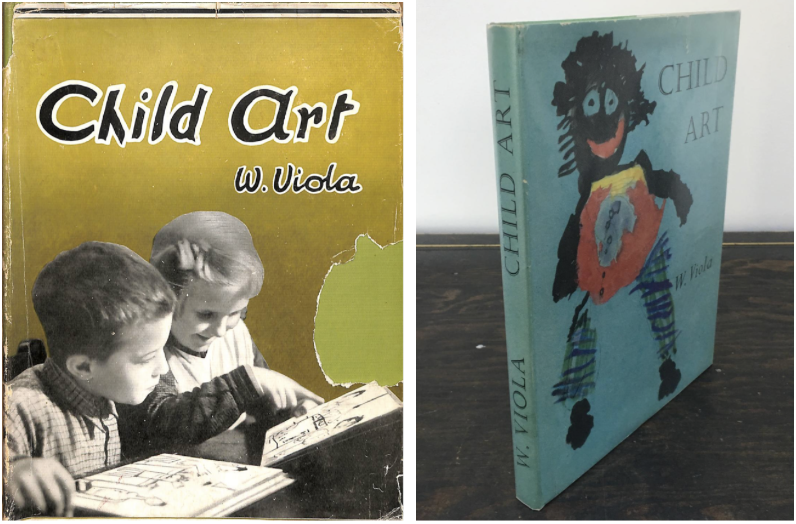
The book from Wilhelm Viola is about the art education methods of the Austrian Franz Cizek. It starts with the history of ‘child art’ as being the history of the discovery of the child “as a human being with his own personality and his own particular laws”, and the importance of Cizek in perceiving the child’s nature. There are several colonialities of thought present throughout the text: a primitivist view of the child; the developmental way of reasoning about children; the whiteness that is not mentioned, although gives sense to the examples given and the subject positions involved; the gardening metaphors used to talk about children’s growing; the adultist and ableist perspectives; a western European framing of art; the relativization, exoticization, and objectification of non-European cultures. These colonialities are embeeded in the discourse as givens that use the figure of the ‘Other’ for the construction of the ‘white’ creative child. We extract one fragment:
“The best way to understand Child Art is to study primitive art, both of races that lived tens of thousands of years ago and the art of living primitives. The most superficial observer must be struck by the similarity between the art of the primitive man and Child Art. In both there is a lack of perspective, of the third dimension, except in Negro sculpture, of shadows; in both there is an inability to represent space. Proportions are different from ours. […] But the optical memory of primitive and child is enormous. Their eyes are better than ours. They see details which we never see, but details only, not the whole. Both produce from imagination”
How close or how distant are you from Viola’s statements?
Have you ever thought how the articulation of the child and creativity was made through a coloniality of thought?
Observe both covers of the book and try to analyze the symbolic layers of the representations.
CM
Comments
child art, primitivisme, imagination
"The term 'child art' itself is very young. Two generations ago nobody dreamt that every child is a born artist, which does not meant that every child should or could become an artist." (p.7)
refers to Rousseau and Spencer
quoting Spencer: "'Shall we therefore repress, or neglect to aid, these efforts at self-culture? or shall we encourage and guide them as normal exercises of the perceptions and the power of manipulations? [...] we condemn the practice of drawing from copies; and still more so, that formal discipline in making straight lines and curved lines and compound lines, with which it is the fashion of some teachers to begin'" (p.8)
quoting Alfred Lichtwark: "'that the child in his representation of things simplifies according to laws which are valid for all times and all peoples, and we have recognised the relation between the first attempts of the child and those of primitive men'" (p.8)
quoting Ebenezer Cooke (1885): "'Imagination some teachers consider their enemie. Accuracy is ever opposed to it... Froebel makes it the very centre of his system; for his aim is education, not instruction, still less decoration. The unfolding of all the child's powers, the easiest and best, - the only way, - is to use its own natural activities. He finds the child a creative being, with active imagination.'" (p.10)
book by Wilhelm Viola "The…
book by Wilhelm Viola
"The term 'child art' itself is very young. Two generations ago nobody dreamt that every child is a born artist, which does not meant that every child should or could become an artist." (p.7)