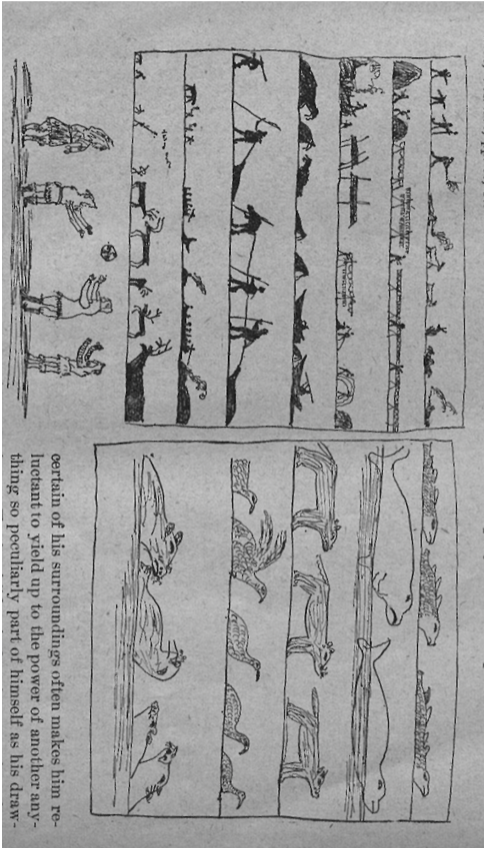
This article from Louise Maitland is based on comparing the western child with the ‘primitive’. The illustrations in the article are “traced copies of the original drawings”. Maitland affirms what, by the end of the 19th century, became a common argument among western ‘white’ educators, psychologists, and art educators: “On comparing the drawings of primitive races with those of children, we find that they possess many points of interest in common. While some of these relate to likenesses, and some to differences, the drawings of both, upon investigation, prove themselves to be a comparable product”. It was not rare, by the times, to compare the ‘white’ western child with the so-called primitive adult. Visual affinities became essential in constructing an epistemology of the eye that sees and categorizes the western white child and the ‘Other’ in a scale of development. The comparison is made to differentiate and produce hierarchies. The comparison of the western ‘white’ child with the ‘Other’ was a form of power in which both the ‘white’ western child and the ‘Other’ were considered as minor subjects. However, while the ‘white’ western child would develop, the ‘Other’ would always be frozen in a scale of development.
“Comparing the Eskimo with the civilized children’s drawings, we find:
The children up to about ten or eleven years, like the Eskimo, use drawings as a language, and choose much the same classes of subjects for illustration, though in varying proportions. […] In the composition or arrangement of their drawings, the children in their younger years show a correspondence with the Eskimo; at an older age they pass more frequently to a higher artistic development”.
In our text, we cut the word Eskimo because it is a western depreciative term to designate the Inuit people, in this case, from Alaska. We use the word ‘primitive’ between commas to accentuate its construction as part of the colonialities of thought.
Why do we consider the child a developing being, going from the simple to the complex in terms of thought? How are art education practices in the present reactivating this developmental perspective on children?
Have you ever thought about the role of comparisons and metaphors in education?
CM