Bruno Munari’s concept of creativity encompassed ideas such as dexterity & acquaintance, experimentation & investigation, collectivity, relatedness and problem-solving. In his book Fantasia, the author expands the significance attributed to creativity, noting on how to stimulate creativity correctly, and simultaneously making clear how erroneous albeit usual some individual and educational habits are in terms of triggering creative practices.
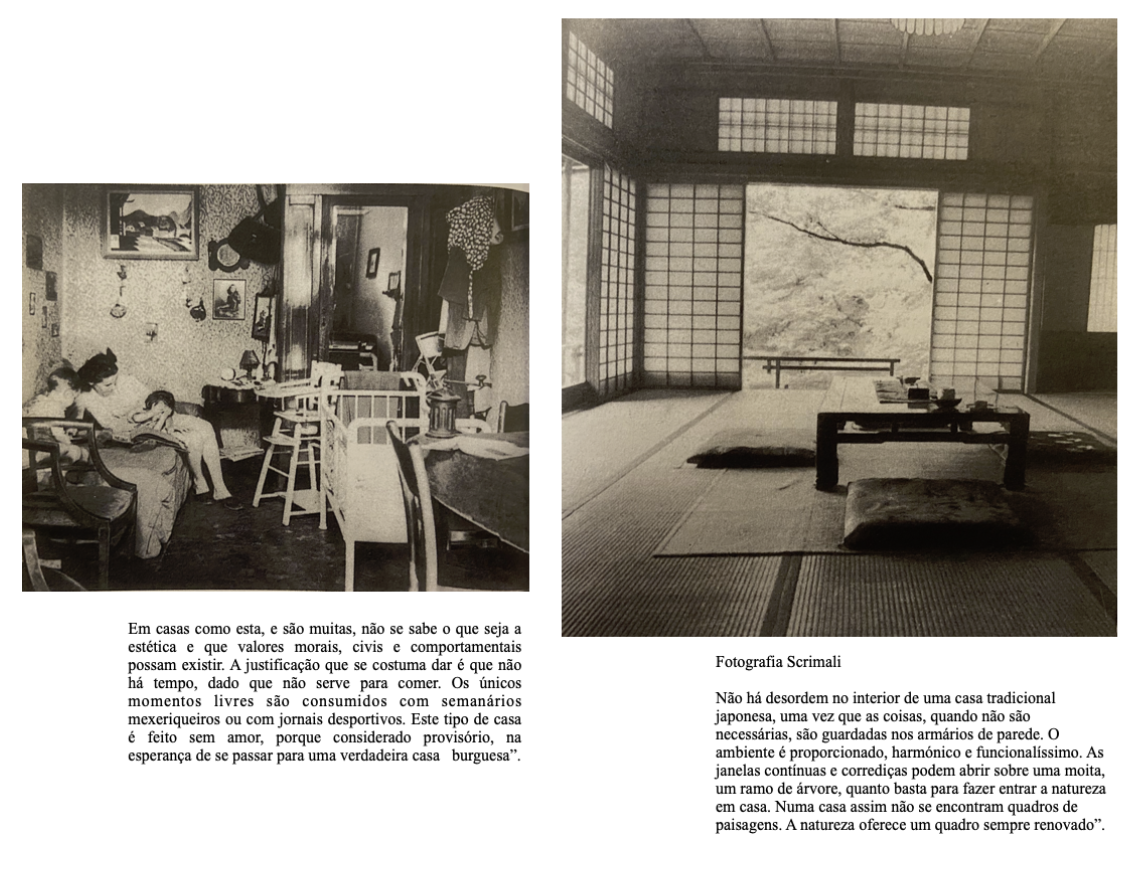
Furthermore, and derived from this, a positive acknowledgment is roundly associated with being creative, and with creative environments. Munari projected his Laboratories (e.g. Tactile Workshops) as an example of a stimulating space; but he further extended the same willful and inspecting eye to the analysis of reality around, on a day-to-day scale. As a result, housing became an important and ubiquitous theme on Munari’s rhetoric on the uses of creativity, where he was able to inquire about the universal utility of design on solving house-related problems, as much as he was predicative on normatizing housing decor and functionality. According to Munari, the functional house is the ideal house, and thus functionality was soon related to a certain moral level to be achieved by the civilized (and the creative) person, as he compares the houses of low classes to those of the Japanese (in general!). The first were helpless and nasty, sheltering the poor, the unloveable and unaccomplished people, while the organized, airy, geometric Japanese- style houses were home for the happy and the good people.
For the third line of the project a few of these notions were particularly ringing in terms of contributing to the definition of the problematic of a good way of living, and on how it would find precepts and pedagogical equivalents in the viralization of good design practices and theories.
In effect, this excerpt of Munari’s considerations on the vital role of minimalism, harmony and proportion, and functionalism are resonant to us, since these have become references in the teaching of visual education. After all, the right ways of reading and speaking the world have common grounds with the right ways of making up posters, book covers, industrial objects or dining room environments. Each of these is ruled by a hygienic approach where inessential things are to discard since they menace the absolute value of simplicity; subjectivity as individual style is to avoid since it endangers the desired universal functionality and collectivity. Following the civilizing Japanese example, and while geometry is regarded as an effective technology in the distribution of people and things in the domestic space, at the same time a cleaning attitude appears in the hope to eradicate the tacky taste, immorality, and the vicious mundanity of the populace, teaching them the values to live better lives in better houses - to eventually become better bourgeois persons, whose problems Munari acknowledges as ‘everyone’s problems’1, like: “How many people do not know what furniture is suitable, do not know what is really needed, do not know how to solve the problem of lighting in an apartment, according to what is intended. They don't know which colors are suitable for each environment; they do not know how to use living space without waste. They do not know how to distinguish the right object from the wrong object for a given purpose”2.
The celebration of the traditional Japanese house, related to the depreciation of the lower class environment (“this kind of house is made without love (...)”3), the equivalence of the first with a more developed and more successful state, must be perhaps one of the most evident examples of how the unmarked normality of whiteness is impregnated in Munari’s rhetorics of good design and creativity. Yet other colonial reminiscences are to be disclosed through this example of the Japanese house, namely art education paternalism in terms of assuming what is good for the others - where minimalism might solve universal problems; or the white, Western, mid-class, non- disabled male as a model and reference for every space and subjective becoming.
The good (design & moral) becomes synonym with organized, ortogonal, restrained, functional, essential, minimal, as well as the light, the uncontaminated or the pure. The good life, allowed by good moral of the good design, is therefore present in the mid-class aspirations and in the white man personification. Assumed as unquestionable goals, these apparent universal desires have migrated and materialized in school grammars and syllabus of visual education, excluding all deviating versions for home interiors and rejecting alternative ways of thinking and communicating visually in a western culture.
The exoticized and artificialized (in terms of its utility) Nature in the background of a glass window is the reinforcing framework of a narrative that imagines its narrator in the center. Traditional Japan is never presented as a trigger for decentering, but instead as an appropriated culture serving western flamboyance and thus arguably falling into the trap of tokenism.
How is the organization of your space intended for specific subjectivities?
Can we think of design as a non-paternalist practice, that is, as something that does not intend to teach users-who-don’t-know-yet the good way to [something]?
Does my perspective include everyone’s problems? Are others’ problems included in everyone’s problems?
CA