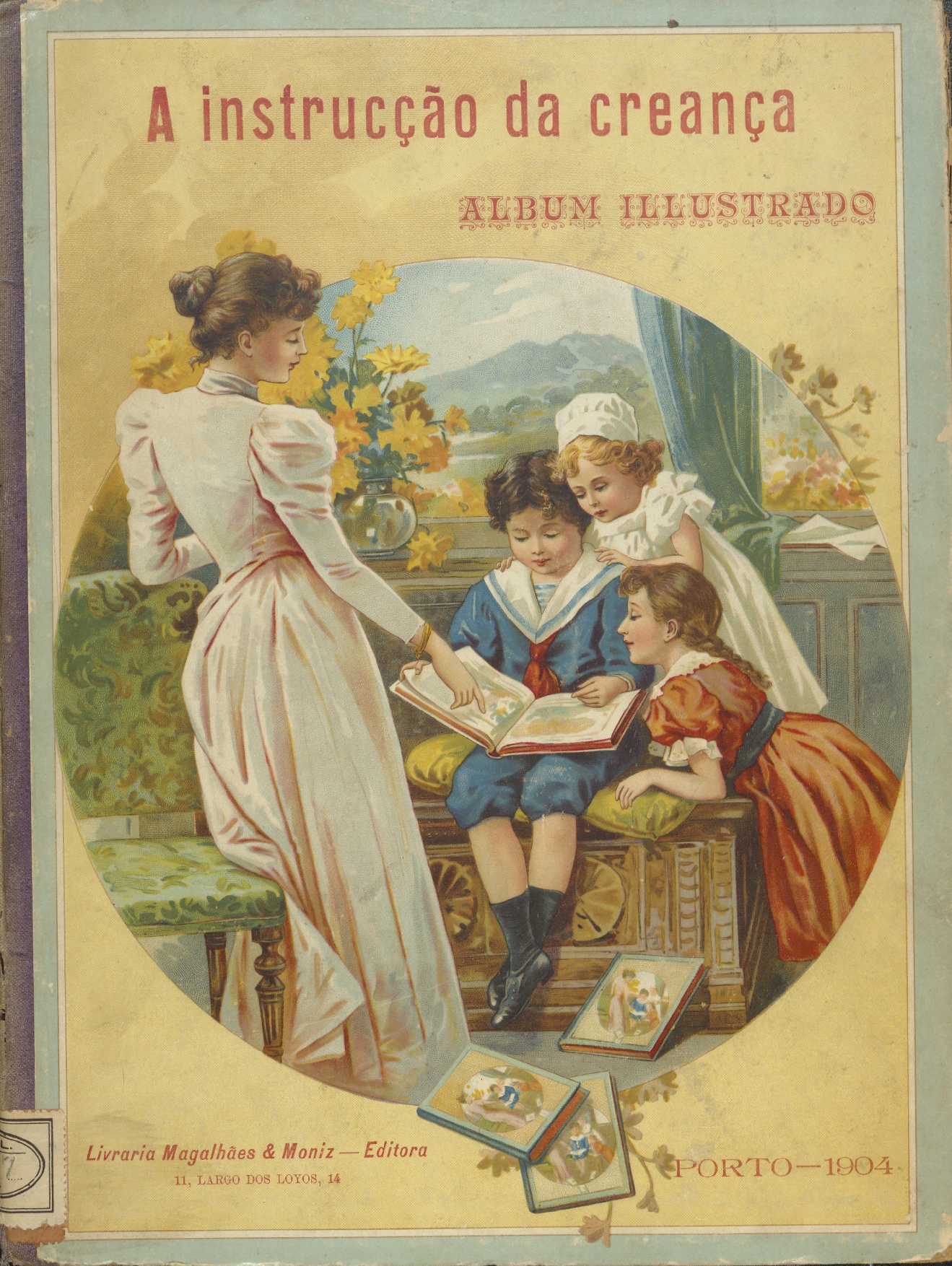
First published in 1875/6 in Switzerland, Johannes Staub’s picture book series A instrucção da creança was translated and published in Portugal in 1904/5. Staub was a teacher and author, committed to progressive and reform education. His picture book series was thought as part of the pedagogical method of the object lesson. This method was popular amongst progressive educators during the 19th and early 20th centuries. Underlying logics were that the child would develop ‘naturally’ by being exposed to the world, by learning from ‘nature’. Through sensory perception – mainly seeing – the objects presented to the child could be categorized and described. The developmental learning path led from the simple to the complex, the near to the far, the concrete to the abstract. ‘Learning to see’ could be the slogan of this method that was quite concretely concerned with controlling the visual sense and how it was employed to create knowledge about the world.
Picture books like Staub’s became important educational tools as images were believed to create sensory imprints on the child’s mind and simultaneously images could be employed to initiate the inputs that were desired by the teachers, or rather, society at large. The cover image of A instrucção da creança reproduces an idea about who the imagined or desired child was: white, middle-class, gender binary conforming, sighted and with a centre stage for the male child. Those lines of representation can be easily traced throughout the entire picture book series. Beyond the representational level, the constitution of a white gaze can be traced that constitutes itself while erasing or disguising itself as invisible (Dyer, Richard (1997): White).
“There is power in looking” (hooks, bell (2003): The Oppositional Gaze, p. 207) and within white cultures it is the white subject who is constituted as the seeing subject, the subject who can visualize the world (hooks, bell (2003): The Oppositional Gaze; Mirzoeff, Nicholas (2011): The Right to Look). Questioning how the white gaze is at play in educational practices, theories and materials gives insight into the construction of the figure of the child. ‘Learning to see’ then erases the white positionality from which the subject is looking at the world, naturalising whiteness as the norm.
What are the challenges in identifying white representations?
Going beyond representation, how is a white gaze at play in the cover picture of A instrucção da creança?
How does whiteness figure in your educational practices or your context?
MS