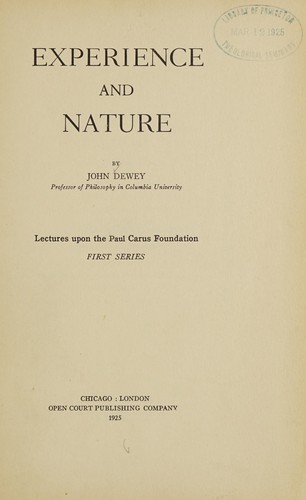
book by John Dewey, 1929. Refers to Boas, The Mind of Primitive Man
"We cannot achieve recovery of primitive naiveté. But there is attainable a cultivated naiveté of eye, ear and thought, one that can be acquired only through the discipline of severe thought" (pp. 37, 38).
"Still more significant is his added remark, that madness has to be construed historically and sociologically. Under primitive conditions all the larger ideas about nature are reveries constructed in the interest of emotions. Myths were fancies, but they were not insanities because they were the only reply to the challenge of nature which existing instrumentalities permitted. Assertion of similar ideas today is insanity, because available intellectual resources and agencies make possible and require radically different adjustments. To entertain and believe fancies which once were spontaneous and general is today a sign of failure, of mental disequilibration. [...] The purpose is to suggest that while the tendency to reverie, to intellectual somnambulism, is universal, the use made of revery - which may roughly stand for the subjective element in mind - depends upon contemporary conditions." (p. 226)
"Although imagination is often fantastic it is also an organ of nature; for it is the appropriate phase of indeterminate events moving forward eventualities that are now but possibilities" (p. 62)


Comments
book by John Dewey, 1929…
book by John Dewey, 1929. Refers to Boas, The Mind of Primitive Man
"We cannot achieve recovery of primitive naiveté. But there is attainable a cultivated naiveté of eye, ear and thought, one that can be acquired only through the discipline of severe thought" (pp. 37, 38).
"Still more significant is his added remark, that madness has to be construed historically and sociologically. Under primitive conditions all the larger ideas about nature are reveries constructed in the interest of emotions. Myths were fancies, but they were not insanities because they were the only reply to the challenge of nature which existing instrumentalities permitted. Assertion of similar ideas today is insanity, because available intellectual resources and agencies make possible and require radically different adjustments. To entertain and believe fancies which once were spontaneous and general is today a sign of failure, of mental disequilibration. [...] The purpose is to suggest that while the tendency to reverie, to intellectual somnambulism, is universal, the use made of revery - which may roughly stand for the subjective element in mind - depends upon contemporary conditions." (p. 226)
"Although imagination is often fantastic it is also an organ of nature; for it is the appropriate phase of indeterminate events moving forward eventualities that are now but possibilities" (p. 62)