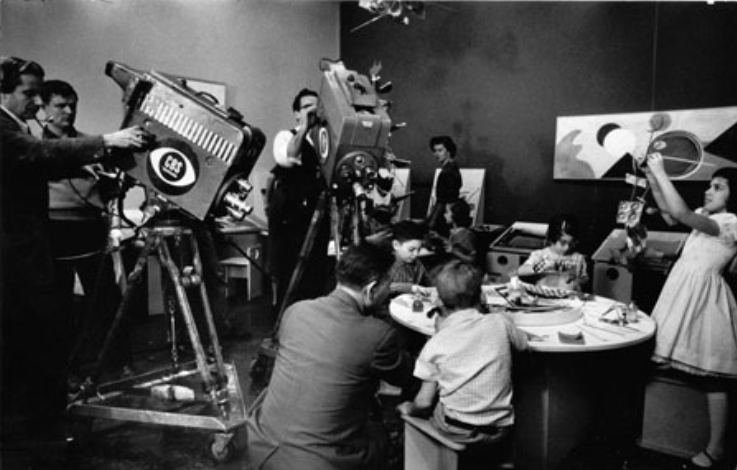
The Education Department at MOMA was directed by the artist and art educator Victor D'Amico. D'Amico traveled through the United States to know art education programs in schools, and has worked previously in settlement houses in New York. D'Amico also passed time at the Black Mountain College. The Children's Art Carnival and Through the Enchanted Gate were two of the most important and experimental programs he created at MOMA. Both programs started from the conviction that children were naturally creative and should be left free from adult interference to develop their creativity. This did not mean that adults were not present, but rather that their role was to observe. Several images from these programs reveal how the function of the educator was put into the preparation of the setting in which the child was obliged to be free. A primitivist framing of his thought about children's authenticity and pureness informs his writings and give also form to the educational programs at MOMA. Adults were not allowed in the spaces, although they could watch through holes what was happening. Having been criticized for this design, Amico replies that it was important that parents and other adult educators, could see in loco how to develop children's creativity. The Children's Art Carnival was a program that traveled to Europe, together with exhibitions to promote Modern Art, particularly Abstract Expressionism. A certain kind of subject, open-minded and creative, was desired. Children were seen as this citizen to be. With the Carnival traveled also the ideas of creativity, imagination, and freedom of expression as symbols of a democratic society. Through the Enchanted Gate was also adapted into a television series. D'Amico stated:
"The object of this program is to emphasize that all children are creative and that the art experience should not be limited to the talented only, or to those regarded as having special gifts. It is hoped that children will enjoy the program and gain in their own development, and also that the parents will realize the importance of good teaching techniques as opposed to those which induce imitation or create competition among children".
CM