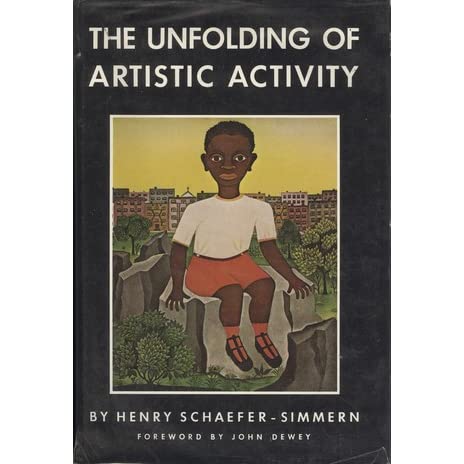
"A study of the teaching methods put into practice in classes for children and adolescents shows a wide preference for the doctrine of self-expression. In contrast to older principles, such as copying, or following imposed techniques, this pedagogical attitude has definite values. It accepts the child as a personality with 'inherent abilities to see, to feel, and to express life.' Leaving him free in his pictorial efforts is the basic educational principle. The child usually enjoys it. Energies are released which give him the feeling of creating something. To the psychologist and psychiatrist this kind of self-expression offers insight into various important psychological processes - a fact which explains why such investigators are less interested in the artistic quality of the child's work than in drawing and painting as a 'projective technique.' Nevertheless, this 'laissez-faire' procedure has many disadvantages. Finger paintings and watercolours painted with big brushes in a fraction of an hour may exhibit many facets of the child's personality, but 'what is sometimes called an art of self-expression might better be termed one of self-exposure; it discloses character - or lack of character - to others. In itself is only a spewing forth." [quoting John Dewey in Art as Experience] At adolescence, critical judgement has usually so far progressed that the young student refuses to recognise his pictorial achievements of self-expression as conforming with his stage of mental development. He loses interest, and thus his pictorial power diminish. Hence, the educational method which aims at self-expression, though it may have psychological values, does not forward the growth of the child's artistic abilities.
In order to overcome the deficiencies of merely 'self-expressive' spontaneous activity in the visual arts, the customary pedagogical practice is to attempt to mould the abilities of the adolescent toward the attainments of the 'Masters'.


Comments
"A study of the teaching…
"A study of the teaching methods put into practice in classes for children and adolescents shows a wide preference for the doctrine of self-expression. In contrast to older principles, such as copying, or following imposed techniques, this pedagogical attitude has definite values. It accepts the child as a personality with 'inherent abilities to see, to feel, and to express life.' Leaving him free in his pictorial efforts is the basic educational principle. The child usually enjoys it. Energies are released which give him the feeling of creating something. To the psychologist and psychiatrist this kind of self-expression offers insight into various important psychological processes - a fact which explains why such investigators are less interested in the artistic quality of the child's work than in drawing and painting as a 'projective technique.' Nevertheless, this 'laissez-faire' procedure has many disadvantages. Finger paintings and watercolours painted with big brushes in a fraction of an hour may exhibit many facets of the child's personality, but 'what is sometimes called an art of self-expression might better be termed one of self-exposure; it discloses character - or lack of character - to others. In itself is only a spewing forth." [quoting John Dewey in Art as Experience] At adolescence, critical judgement has usually so far progressed that the young student refuses to recognise his pictorial achievements of self-expression as conforming with his stage of mental development. He loses interest, and thus his pictorial power diminish. Hence, the educational method which aims at self-expression, though it may have psychological values, does not forward the growth of the child's artistic abilities.
In order to overcome the deficiencies of merely 'self-expressive' spontaneous activity in the visual arts, the customary pedagogical practice is to attempt to mould the abilities of the adolescent toward the attainments of the 'Masters'.