

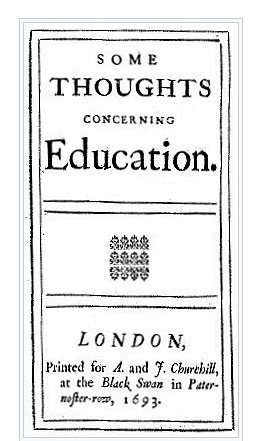
Some Thoughts Concerning Education is a treatise first published in 1693 in London. It was translated into almost all of the major written European languages during the eighteenth century, and nearly every European writer on education after Locke, including Jean-Jacques Rousseau, acknowledged its influence.
John Locke was born at Pensford, Bristol (1632), and died in 1704.
+ information: https://en.wikipedia.org/wiki/Some_Thoughts_Concerning_Education
fragments:
"130. Play-things, I think, Children should have, and of diverse sorts; but still to be in the Custody of their Tutors or some body else, whereof the Child should have in his Power but one at once, and should not be suffered to have another but when he restored that. [...] Though it be agreed they should have of several sorts, yet, I think, they should have none bought for them. This will hinder that great variety they are often overcharged with, which serves only to teach the mind to wander after change and superfluity, to be unquiet, and perpetually stretching itself after something more still, though it knows not what, and not to be satisfied with what it hath. [...] 'How then shall they have the Play-games you allow them, if none must be bought for them?' I answer, they should make them themselves, or at least endeavour it, and set themselves about it; till then they should have none, and till then they will want none of any great Artifice. [...] Indeed, when they once begin to set themselves to work about any of their invention, they should be taught and assisted." (pp. 112, 113)
Comments
Play-things, play
"130. Play-things, I think, Children should have, and of diverse sorts; but still to be in the Custody of their Tutors or some body else, whereof the Child should have in his Power but one at once, and should not be suffered to have another but when he restored that. [...] Though it be agreed they should have of several sorts, yet, I think, they should have none bought for them. This will hinder that great variety they are often overcharged with, which serves only to teach the mind to wander after change and superfluity, to be unquiet, and perpetually stretching itself after something more still, though it knows not what, and not to be satisfied with what it hath. [...] 'How then shall they have the Play-games you allow them, if none must be bought for them?' I answer, they should make them themselves, or at least endeavour it, and set themselves about it; till then they should have none, and till then they will want none of any great Artifice. [...] Indeed, when they once begin to set themselves to work about any of their invention, they should be taught and assisted." (pp. 112, 113)